

Creative Writing Prompts for Kids: 60+ Ideas
Table of Contents
- How to Teach Creative Writing to Children
- Story Starters for Elementary Students
- Creative Writing Prompts for Kids Who Resist Writing
- Journaling Prompts for Kids
- Writing Games for Kids: Making Practice Feel Like Play
- Creative Writing Prompts for Kids: Digital vs. Analog Tools
- Simple Rubric for Assessing Kids' Creative Writing
- Conclusion
Last Updated: August 12, 2026
Creative writing prompts for kids build literacy skills, narrative thinking, and writing confidence. A blank page can feel overwhelming to a young writer, but the right prompt changes everything. Below, you'll find 60+ prompts organized by grade level and learning style, plus practical strategies for making writing feel less like a chore and more like an adventure.
A third-grader and a second-grader are not the same writer. A child who resists writing needs a different entry point than one who fills notebooks willingly. This guide addresses all of that, including neurodivergent-friendly approaches, collaborative writing, and a simple rubric for assessing what kids produce.
According to the National Council of Teachers of English's position on writing instruction, writing development is most effective when students write frequently, for real purposes, and with meaningful feedback. The prompts here are built around that principle.
How to Teach Creative Writing to Children
Teaching creative writing to children works best when the goal is engagement before correctness. Writing fluency comes from volume and practice, not from fixing every sentence before it's finished.
Start With Low-Stakes, High-Interest Topics
The biggest mistake is starting with a topic the child doesn't care about. Interest drives vocabulary building, sentence structure, and writing stamina more than any direct instruction. Ask a child to write about their favorite animal, an imaginary superpower, or the weirdest thing they've ever eaten. Low-stakes means no grade, no red pen, no reading aloud unless the child chooses it. The goal at this stage is writing habit, not writing mechanics.
Build Writing Stamina Gradually
Writing stamina is the ability to write continuously without stopping. Most elementary students start with two to three minutes of sustained writing. Build from there in small increments:
- Set a visible timer for two minutes
- Give one open-ended prompt
- When time is up, ask the child to read their favorite sentence back
- Add one minute the following session
Over six to eight weeks, many children reach ten to fifteen minutes of focused writing without prompting.
Story Starters for Elementary Students
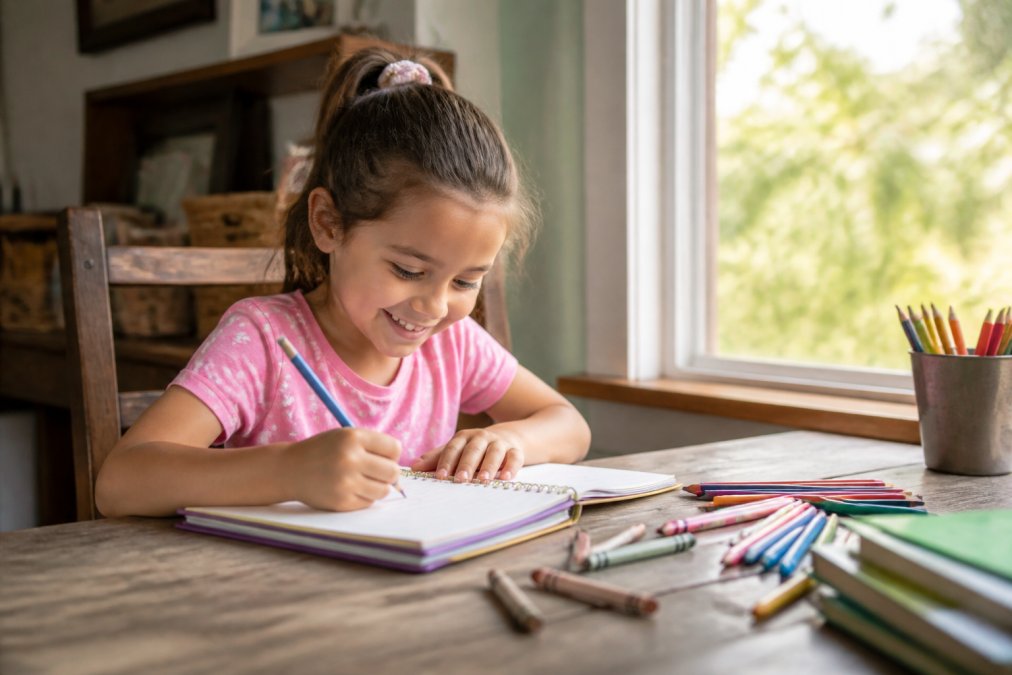
Story starters work because they remove the hardest part of writing: starting. A strong story starter hands the child the first sentence and lets their imagination take over from there.
Grades K-2: Simple and Imaginative
These prompts are designed for early writers still building letter formation and sentence structure. Keep them short. Let the child dictate if writing is still laborious.
- One day, a tiny dragon moved into my backpack.
- I found a door in the middle of the forest that wasn't there yesterday.
- My cat learned to talk, and the first thing she said was...
- If I could fly for one day, I would go to...
- The robot at the library could do everything except...
- I woke up and the whole world was made of candy.
- My best friend is invisible, and nobody believes me.
- The moon fell into our backyard last night.
- A fish swam up to me and handed me a map.
- Every time I sneezed, something strange happened.
Grades 3-5: Adventure and Character-Driven
Older elementary students are ready for character development, plot structure, and descriptive language. These prompts push toward narrative writing with stakes and conflict.
- The spaceship landed in the school parking lot, and the pilot asked for me by name.
- I discovered my grandmother had been a spy for thirty years.
- The new kid at school had no shadow.
- We were halfway up the mountain when we realized we were being followed.
- The map was old, torn, and had my handwriting on it, but I'd never seen it before.
- My robot double went to school for me, and things did not go as planned.
- The library book was overdue by one hundred years.
- I won a contest to name a new planet, but the prize wasn't what I expected.
- Every door in our house led somewhere different today.
- The last explorer who came back from that island never spoke again.
Creative Writing Prompts for Kids Who Resist Writing
Most approaches to reluctant writers focus on motivation. The real issue is often anxiety. A child who says "I don't know what to write" is usually saying "I'm afraid of doing it wrong." The fix is removing the conditions that make failure feel possible.
Neurodivergent-Friendly Prompts and Approaches
Neurodivergent children, including those with ADHD, dyslexia, or autism spectrum differences, often thrive with creative writing when the format changes.
Oral-first writing: Let the child tell the story aloud while a parent types or records it. Transcribe it. That becomes their "writing."
Draw-then-write: The child draws the scene first, then writes one sentence about it. Many children with dyslexia find that drawing activates the narrative part of their brain before the mechanical demands of writing kick in.
Choice-based prompts: Give three options, not one. Choice reduces the paralysis of a blank page.
Neurodivergent-friendly prompts to try:
- Draw your character. Now write three words that describe them.
- What is the loudest sound your character has ever heard?
- Your character can only communicate by drawing pictures. What do they draw?
- Finish this sentence in exactly five words: "The best hiding spot was..."
- Write the last sentence of your story first.
- Your character has one rule they never break. What is it?
According to the International Dyslexia Association's guidance on writing support, multimodal approaches that separate composition from transcription significantly reduce writing anxiety in students with language-based learning differences.
Collaborative Writing Prompts for Pairs or Groups
Collaborative writing builds writing confidence faster than solo practice for many children, because the social element makes the stakes feel lower.
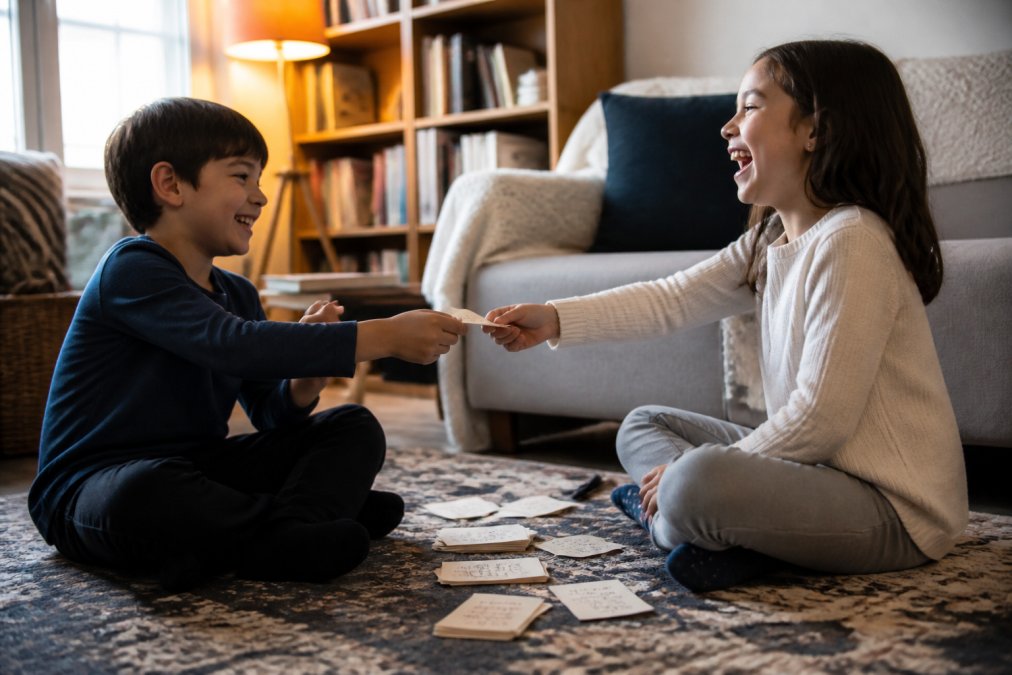
Pass-the-story method: One child writes the opening sentence. The next adds a sentence. Rotate until the story reaches a natural ending.
Story swap: Each child writes the first paragraph of a story, then trades with a partner who writes the second. Swap back for the ending.
Collaborative prompts:
- Write a story where two characters disagree about something important, and both are right.
- One of you writes the hero's side. The other writes the villain's side. Read them together.
- Start a story with "Nobody expected the storm to bring..." and pass it after three sentences.
- Each person adds one clue to a mystery. See if anyone can solve it at the end.
- Write a conversation between two characters who have never met but are about to change each other's lives.
Journaling Prompts for Kids
Journaling prompts serve a different purpose than story starters. Where narrative writing builds plot and character, journaling builds self-expression, emotional vocabulary, and writing habit.
Self-reflection prompts:
- What is something you're good at that most people don't know about?
- Describe a moment when you felt really proud of yourself.
- What does a perfect Saturday look like from the moment you wake up?
- Write about a time you changed your mind about something.
- What would you tell your five-year-old self?
- What's something you wish adults understood about being a kid?
- Describe your favorite place using only your five senses.
- What's a question you've never been able to answer?
- Write about someone who makes you feel safe.
- If you could change one rule at school, what would it be and why?
Fantasy journaling prompts:
Join the Miso & Kili Co-Pilot Club! →
- You are the first person to discover a new color. What is it called?
- Write a diary entry from the perspective of your pet.
- You've been hired as the official taste-tester for a magical bakery. Describe your first day.
- You found a journal that predicts the future. What does it say about tomorrow?
Journaling works best when it's private by default. Tell children their journal is theirs. No one reads it without permission.
Writing Games for Kids: Making Practice Feel Like Play
Writing games turn practice into something children ask to do again. The key is removing the "assignment" feeling entirely.
Story dice: Roll two standard dice. Assign a character to one number and a setting to another. The child writes a story using both.
First-line challenge: Read the opening line of a real book without saying the title. The child writes what they think happens next. Then reveal the real story. Compare versions.
Word-of-the-day story: Pick one unusual word each morning. By dinner, the child has to use it in a written sentence or short story.
Exquisite corpse: Fold a piece of paper into thirds. Person one writes the opening, folds it over. Person two writes the middle without reading the beginning, folds it over. Person three writes the ending. Unfold and read aloud.
Creative Writing Prompts for Kids: Digital vs. Analog Tools
Creative writing prompts can be delivered digitally or on paper, and the format genuinely affects how children engage with them.
| Format | Best For | Limitations | Example Tools |
|---|---|---|---|
| Analog (paper, journals) | Building handwriting, reducing distraction, screen-free households | Less interactive, harder to revise | June & Lucy journals, 642 Things to Write About |
| Digital (apps, websites) | Reluctant writers who engage better with screens, classroom use | Requires device, can become passive | StoryJumper, Scholastic Story Starters |
| Hybrid (print prompts + digital publishing) | Children who want to "publish" their work | Requires both setup | StoryJumper for publishing, physical journal for drafting |
StoryJumper (storyjumper.com) lets children design characters, write, and illustrate their own digital books, with an option to print a physical copy. Scholastic Story Starters (scholastic.com) generates prompts across fiction, adventure, fantasy, and science fiction. 642 Things to Write About: Young Writer's Edition offers 642 diverse prompts in a physical journal format.
Handwriting activates more of the brain's language centers, and the physical act of crossing out and rewriting teaches revision in a way that hitting delete does not. For families committed to screen-free learning, a well-chosen journal and a strong prompt list is the better tool.
Miso & Kili's Adventures takes the screen-free approach seriously. The Co-Pilot Club's monthly missions are designed to extend the adventure of reading into hands-on, offline activities, including writing challenges that connect directly to the books.
Additional prompts for digital-friendly writing:
- Write the "About the Author" page for a book you haven't written yet.
- Create a social media profile for a fictional character. What do they post about?
- Write the instructions for a game you invented.
- Compose a text message conversation between two historical figures.
- Write the review a villain would leave for the hero on a review site.
According to the International Literacy Association's research on digital and print reading, children who engage with both print and digital formats develop stronger overall literacy skills than those limited to one medium.
Simple Rubric for Assessing Kids' Creative Writing
Assessment is the most skipped step in home and classroom creative writing practice. Without it, children don't know what to aim for, and parents don't know what to celebrate.
| Criterion | Beginning (1) | Developing (2) | Accomplished (3) |
|---|---|---|---|
| Ideas | Unclear or minimal | One central idea, some detail | Clear idea with specific, original details |
| Voice | Flat or generic | Some personality present | Distinctive, engaging voice throughout |
| Organization | No clear beginning/middle/end | Partial structure | Clear narrative arc |
| Word Choice | Repetitive or vague | Some varied vocabulary | Precise, vivid descriptive language |
| Conventions | Many errors that obscure meaning | Some errors, meaning is clear | Few errors, writing is clean |
Use this rubric as a conversation starter, not a verdict. Walk through it with the child. Ask them where they think they landed on each criterion and why.
Additional prompts for older elementary students:
For expository writing practice: 51. Explain how to make your favorite meal to someone who has never cooked before. 52. Write three reasons why your favorite season is the best. 53. Teach a younger child how to do something you're good at.
For persuasive writing: 54. Write a letter convincing your family to get a pet. 55. Argue that homework should be optional. 56. Convince the principal to add one new class to the school day.
For descriptive language practice: 57. Describe your bedroom to someone who has never seen it. 58. Write about rain without using the word "wet." 59. Describe a sound using only visual words. 60. Write about your favorite food without naming it.
Bonus prompts for writing workshops: 61. Rewrite a fairy tale from the villain's point of view. 62. Write a story that starts at the end and works backward. 63. Create a creature that has never existed. Describe it so clearly that someone could draw it.
Building a writing habit in children takes consistency more than inspiration. The prompts matter, but what matters more is showing up regularly, keeping the stakes low, and celebrating the act of writing itself. At Miso & Kili's Adventures, our award-winning books and Co-Pilot Club monthly missions are designed to do exactly that: give children a reason to keep exploring, keep imagining, and keep putting words on the page. Join the Miso & Kili Co-Pilot Club and give your young writer a monthly adventure that extends far beyond the last page.
Frequently Asked Questions
How do writing prompts help with literacy development?
Writing prompts give children a clear starting point, which removes the anxiety of a blank page. That first sentence unlocks vocabulary building, sentence structure practice, and narrative thinking all at once. Regular prompt-based writing builds writing fluency over time, so children learn to organize ideas, develop characters, and sustain a story. Even five minutes of daily prompted writing strengthens reading comprehension, because kids who write actively notice how stories are constructed when they read.
How can I make writing fun for reluctant writers?
Swap the pressure of 'write a story' for a low-stakes game. Try story card challenges, collaborative round-robin writing where each person adds one sentence, or prompts tied to the child's specific interests, animals, space, sports, or favorite characters. Letting kids dictate while a parent writes, then switching roles, also reduces the physical barrier for children who struggle with handwriting. Celebrating any output, even one sentence, builds writing confidence faster than correcting mechanics.
What are some good creative writing prompts for elementary school journaling?
Good journaling prompts for kids at the elementary level mix self-reflection with imagination. Try: 'What would your perfect day look like from breakfast to bedtime?' or 'If your pet could talk, what's the first thing it would say?' For self-expression, prompts like 'Describe a time you felt really proud of yourself' help children process emotions alongside building literacy skills. Rotating between imaginative and personal prompts keeps the writing habit fresh and prevents the journal from feeling repetitive.
How do you introduce creative writing to a child who has never done it before?
Start with oral storytelling before pencil meets paper. Ask the child to tell you a short story out loud, then say, 'Let's write that down.' This shows them they already know how to create narratives. From there, use a single story starter, one sentence they finish in their own words. Keep early sessions to five minutes. The goal at first is writing engagement and confidence, not length or perfect writing mechanics. Praise the ideas, not just the spelling.
This article was written using GrandRanker