

Educational Monthly Subscription Box Review 2026
Table of Contents
- How to Choose an Educational Subscription Box That Actually Delivers
- Best STEM Subscription Boxes for Kids: What the Market Offers
- Educational Subscription Box Review: Miso & Kili Co-Pilot Club
- Verdict: Which Educational Subscription Box Should You Pick?
Last Updated: August 13, 2026
Parents searching for quality educational subscription boxes often discover the same frustrating truth: most roundups are affiliate link farms dressed up as editorial content. At Miso & Kili's Adventures, we've examined what actually makes an educational subscription box worth a child's attention and a parent's money. Below, we provide a framework for evaluating any box, an overview of the current STEM subscription space, and a detailed review of our Co-Pilot Club.
The best educational subscription box depends on three factors: age-appropriate content, genuine skill-building, and long-term engagement. Most boxes nail one or two. Very few nail all three.
How to Choose an Educational Subscription Box That Actually Delivers
The single most important filter is age-appropriateness. A box calibrated for a 4-year-old will bore a confident 7-year-old reader. Always check the stated age range against your child's actual developmental milestones.
Beyond age fit, here are the criteria that separate genuinely educational kits from glorified craft supply deliveries:
- Curriculum alignment: Does the content connect to real learning outcomes, literacy, geography, critical thinking, problem-solving, or is it purely decorative?
- Instructional clarity: Can a child follow the activity booklet independently, or does every project require significant parental guidance?
- Hands-on learning depth: Multi-step projects build cognitive development far better than single-session crafts.
- Durable materials: Cheap supplies that break or bleed through pages undermine the entire experience.
- Cancellation policy: Flexible month-to-month subscriptions signal confidence in the product. Recurring billing that traps you is a red flag.
- Giftability: Does the box arrive in presentable condition with clear context for the recipient?
Storage and organization is a real practical concern. Activity books and craft supplies accumulate fast. The best providers design content to fit neatly into a standard folder or small bin.
Neurodivergent-friendly design matters significantly. Children with sensory sensitivities, attention differences, or reading challenges benefit from boxes offering flexible pacing, low-pressure activities, and clear visual instructions. According to CDC data on developmental disabilities in children, roughly one in six children in the United States has a developmental disability, making inclusive design a necessity, not a bonus.
| Criteria | What to Look For | Red Flag |
|---|---|---|
| Age range | Matches child's reading and motor skill level | Vague "4-12" range with no differentiation |
| Skill development | Literacy, STEM, geography, or arts focus | Generic "fun" with no stated learning outcomes |
| Materials quality | Durable paper, non-toxic supplies | Thin pages, supplies that bleed or break |
| Instructional clarity | Child-led with minimal adult setup | Requires 20+ minutes of adult prep per activity |
| Cancellation policy | Month-to-month or easy pause option | Annual lock-in with no refund |
| Storage fit | Compact, organizable format | Oversized irregular pieces |
| Neurodivergent-friendly | Visual instructions, flexible pacing | Dense text, timed activities |
Best STEM Subscription Boxes for Kids: What the Market Offers
The best STEM subscription boxes treat hands-on learning as the vehicle, not the destination. The destination is a child who finishes a project and immediately asks "what's next?"

The current market breaks into three broad categories.
Science and engineering kits focus on circuit building, chemistry experiments, and coding fundamentals for children aged 7 and up. These require fine motor skills and attention span for multi-step projects. Cost-per-box runs higher due to physical components.
Geography and culture boxes send children on monthly "missions" to different countries or regions, combining activity books, crafts, and cultural context. These work particularly well for younger children aged 4-7.
Reading and adventure kits blend creative play with literacy development. These sustain long-term engagement when children connect with recurring characters across multiple books and missions. According to American Academy of Pediatrics guidance on reading and literacy development, children develop stronger literacy outcomes when reading is embedded in meaningful storytelling rather than treated as standalone skill exercise.
Educational Subscription Box Review: Miso & Kili Co-Pilot Club
The Miso & Kili Co-Pilot Club is a strong option in the reading-and-adventure category for children aged 4-10, particularly for families prioritizing screen-free entertainment, values-based storytelling, and creative play.
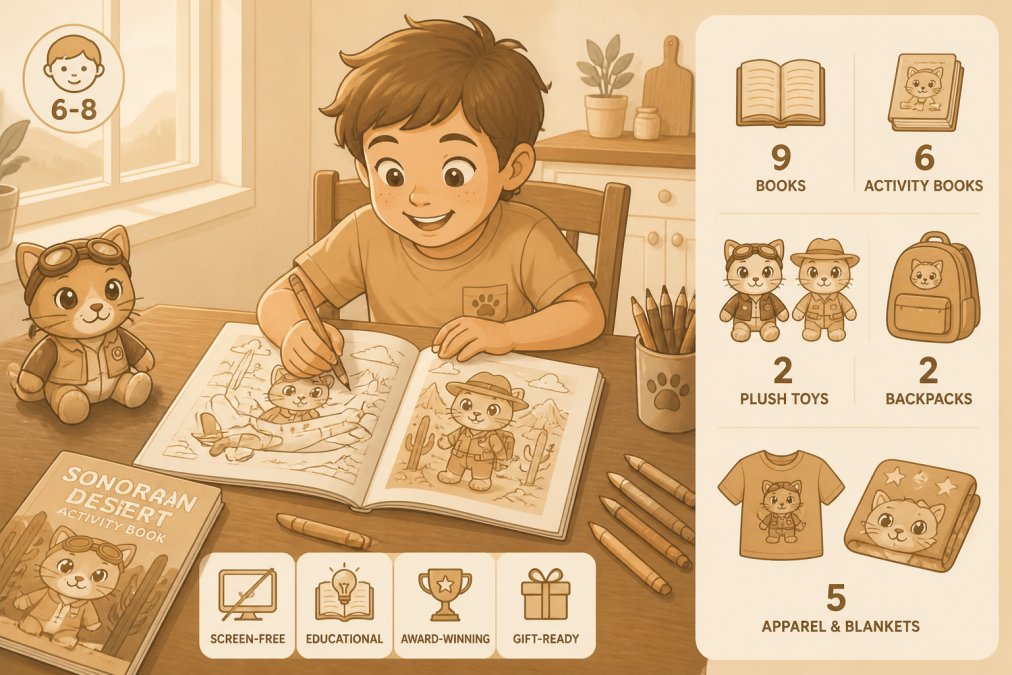
The foundation is the award-winning Miso & Kili book series. The New Island Friends storybook won the 2024 PenCraft Seasonal Book Award. The books follow Miso and Kili, two adventurous pilot cats, across six volumes from tropical islands to Alaska to the Sonoran Desert to outer space. The series grows in complexity alongside the reader.
What the Co-Pilot Club delivers:
- Monthly missions that extend the story beyond the page, giving children an active role
- Activity books paired to each storybook, combining coloring pages, puzzles, and creative prompts
- A screen-free adventure newsletter supporting the mission structure
- Author-signed books with real paw prints from Miso and Kili, a keepsake detail that matters for children forming strong character attachments
Pricing:
Join the Miso & Kili Co-Pilot Club! →
| Product | Format | Price |
|---|---|---|
| Activity Book Bundle (3 adventures) | Softcover | $24.99 |
| New Island Friend Activity Book Bundle | Storybook + Activity Book | $24.99 |
| Space Adventures Softcover Bundle (Books 5-6) | Softcover | $32.99 |
| Complete Series Set (Books 1-6) | Softcover | $74.95 |
| Individual Activity Books | Digital download | $4.99 each |
The digital download option at $4.99 per activity book is worth highlighting for budget-conscious families or homeschool teachers who want to print and reprint pages.

Homeschool fit: The Co-Pilot Club works as a curriculum supplement because missions have a structured, sequential format. Each book introduces real geography and ecosystems, giving parents natural hooks for broader unit studies.
Neurodivergent-friendly considerations: Activity books use visual, image-led instructions with manageable page counts. The flexible, self-paced format means a child can complete one puzzle one day and return to coloring pages the next without losing the thread. There are no timed activities or performance metrics.
The honest limitation: The Co-Pilot Club is not a traditional STEM subscription box in the circuits-and-chemistry sense. If your child's primary interest is engineering or coding, this is not the right fit.
Verdict: Which Educational Subscription Box Should You Pick?
Most boxes look better in YouTube unboxings than they perform over six months of actual use.
For families whose children are drawn to adventure, animals, and imaginative storytelling, the Miso & Kili Co-Pilot Club is a clear recommendation in the reading-and-creative-play category. The award-winning book series, structured monthly missions, and activity books make it a coherent educational experience rather than disconnected craft projects. The complete six-book softcover set at $74.95 represents the best long-term value.

For families primarily seeking STEM activities with a science or engineering focus, look to providers specializing in physical science kits.
Quick Picks:
- Best for ages 4-8 who love stories and creative play: Miso & Kili Co-Pilot Club
- Best entry point for new families: New Island Friend Activity Book Bundle at $24.99
- Best for homeschool curriculum supplementation: Complete Series Softcover Set at $74.95
- Best budget option: Digital activity book downloads at $4.99 each
The best educational subscription box is the one your child asks to return to. Sustained engagement is the only metric that actually matters. Miso & Kili's Adventures addresses this through a continuing narrative that gives children a reason to care about the next mission before it arrives. Join the Miso & Kili Co-Pilot Club and give your child an adventure that grows with them.
Frequently Asked Questions
Are educational subscription boxes actually worth the cost?
They can be, but the value depends on how well the box matches your child's age, interests, and learning style. Boxes that combine hands-on learning with curriculum-aligned content tend to hold a child's attention longer. If the activities reinforce problem-solving skills and creative play rather than one-off novelty, the cost-per-box becomes easier to justify. For families who homeschool or want screen-free entertainment, a well-chosen educational subscription box often replaces several separate purchases.
What are the best STEM subscription boxes for elementary-aged kids?
The strongest STEM subscription boxes for kids aged 4-10 pair project-based learning with clear instructional guidance so children can work with minimal adult help. Look for boxes that build on prior skills each month rather than delivering unrelated one-off kits. For children who also love reading, options that combine STEM activities with an activity booklet or storybook provide better long-term engagement and stronger developmental milestones than activity-only formats.
How do I choose the right educational subscription box for my child's age?
Start with the publisher's stated age range, then check whether the cognitive demand matches your child's current skill level, not just their age. A box rated for ages 4-8 that skews toward the lower end will feel too easy for a confident reader. Also check whether the provider offers a cancellation policy that lets you stop or pause if your child loses interest, and whether the materials are durable enough to withstand repeat use without falling apart after one session.
Are there affordable alternatives to monthly educational subscription boxes?
Yes. One strong option is purchasing activity book bundles directly rather than committing to a recurring billing cycle. The Miso & Kili Activity Book Bundle, 3 Adventures in One, priced at $24.99, delivers three full activity books covering geography, puzzles, and creative play. Digital downloads of individual activity books start at $4.99 and can be printed repeatedly, making them a flexible homeschool supplement or low-commitment starting point before signing up for any monthly delivery service.
Can educational subscription boxes work as homeschool curriculum supplements?
Many can, provided the content is curriculum-aligned and structured enough to build skills progressively. Look for boxes that include an activity booklet with clear learning outcomes rather than loose craft supplies with no instructional clarity. The Miso & Kili Co-Pilot Club pairs award-winning storybooks with monthly missions designed to reinforce reading, critical thinking, and geography awareness, making it a practical homeschool supplement for families seeking values-based, project-based learning without screen time.
This article was written using GrandRanker