

How to Encourage Independent Play Without Screens
Table of Contents
- Why Independent Play Without Screens Builds Focus
- Screen Free Educational Activities for Kids at Every Age
- How to Set Up a Toy Rotation and a Play Space That Works
- Setting Boundaries Without a Fight
- Troubleshooting Clingy Phases and Neurodivergent Kids
- Frequently Asked Questions
Last Updated: September 16, 2026
Why Independent Play Without Screens Builds Focus
Independent play is child-led activity a child chooses, directs, and sustains alone, without an adult structuring each step or a screen entertaining them. Attention span grows through repeated, low-pressure practice, practice that never happens when a screen fills every quiet moment. The American Academy of Pediatrics guidance on screen time notes that unstructured, screen-free time supports healthy cognitive and social-emotional development.
Screen Free Educational Activities for Kids at Every Age
Screen free educational activities for kids work best when they match what a child can already do, then stretch it slightly. The setup matters more than the activity: a four-year-old with three crayons and one coloring page engages longer than the same child in front of a full craft closet.
- Ages 4-5: sensory play, puzzles, coloring. Expect 10-15 minutes.
- Ages 6-7: imaginative play, drawing, building. Expect 20-30 minutes.
- Ages 8-10: chapter books, complex puzzles, LEGO. Expect 30-45 minutes or more.
Activity and coloring books combine structure with open-ended creativity. Our Miso & Kili Activity Book Bundle pairs coloring pages and puzzles with adventure themes across three settings, giving kids a reason to keep turning pages alone.

How to Set Up a Toy Rotation and a Play Space That Works
A toy rotation keeps only a small selection of toys accessible and stores the rest out of sight, swapping on a regular schedule. Fewer options means deeper engagement with each one.
- Sort into four or five bins by category, building, art, pretend play, puzzles and games, books.
- Keep one bin out at a time, storing the rest out of sight.
- Swap bins every one to two weeks so a returning bin feels new again.
- Set up the space low and reachable, a child-height shelf, a rug, art supplies within arm's reach.
- Keep the space boring on purpose, no screens, no flashing toys, no background television.
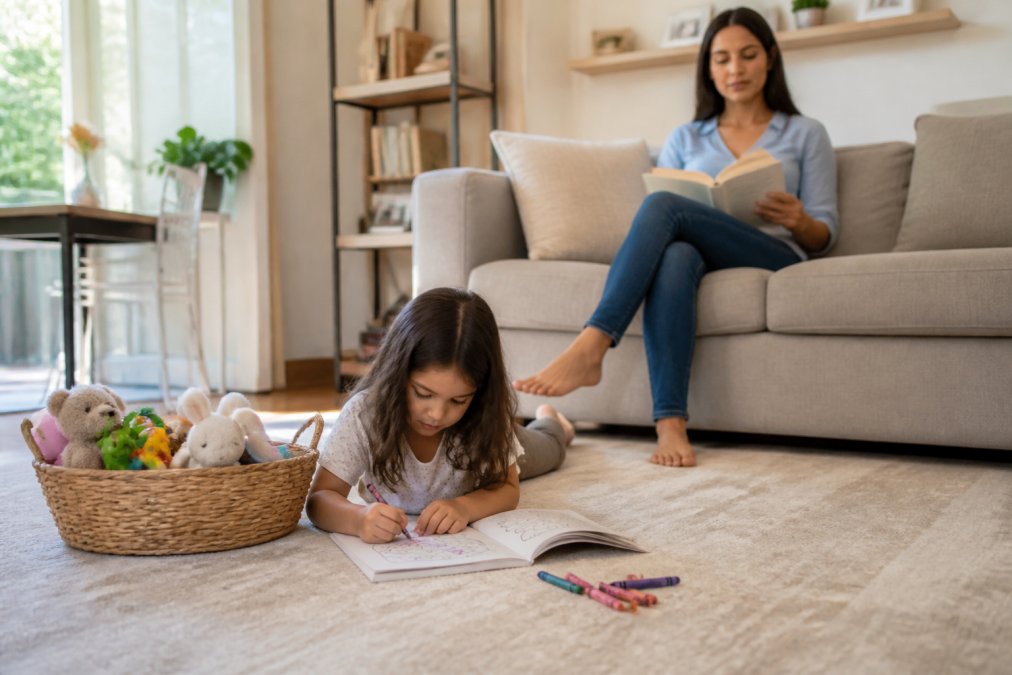
Setup: about 45 minutes the first time, then 10 minutes per swap. You'll need: four to five bins, one low shelf or basket, and a defined floor space. Expected result: within two to three weeks, most families notice children settling into activities for longer stretches before asking for a screen.
Setting Boundaries Without a Fight
Boundaries work when they are predictable, not strict. A child who knows screens come on after dinner and not before does not negotiate every afternoon.
- Announce the boundary once, calmly, then hold it. Repeating it turns it into a debate.
- Give a transition warning. "Five more minutes, then the tablet goes on the counter." Transitions, not the boundary, cause most meltdowns.
- Reinforce the behavior you want. "You played on your own for a whole puzzle. That was great focus."
- Model it yourself. If you reach for your phone during their play, the boundary reads as a rule for kids only.
Consistency beats intensity: ten calm afternoons in a row do more than one perfect screen-free weekend.
Miso & Kili Activity Book Bundle — 3 →
Troubleshooting Clingy Phases and Neurodivergent Kids
For clingy phases, sit nearby without directing, your presence is the training wheels. Read your own book while they play, then move a little further away over days, so supervised play gradually becomes independent exploration.
For neurodivergent children, the same principles apply with adjustments:
- Shorter stretches, more repetition. Ten focused minutes ending in success beats thirty ending in tears.
- Visual schedules and timers. Knowing what comes next reduces the anxiety that drives clinginess.
- Deep-interest activities. Follow the interest, not the activity list.
- Sensory play as a regulator. Water, sand, and play dough often settle a dysregulated child faster than a verbal redirect.
The measure of progress is not a perfectly independent child. It is a child who needs you a little less this week than last week. Track the trend, not the day.
Frequently Asked Questions
How do you encourage independent play without screens?
Start with a short, realistic block of time, around 10 to 15 minutes for younger kids, and build from there. Set up a defined play space with a few open-ended toys or an activity book within reach. Stay nearby but busy with your own task so your child can see you without needing you. When they finish, praise the effort, not the outcome. Repeat daily so independent play becomes a habit rather than a one-off request.
What are the best screen free educational activities for kids who ask for a tablet constantly?
Keep a small rotation of hands-on options visible and ready: coloring and puzzle books, building blocks, sensory bins, and simple pretend-play props. Activity books work well because they give kids a clear starting point without needing an adult to direct every step. When your child asks for a screen, redirect to one specific activity rather than a vague 'go play.' Offering one clear choice usually works better than listing five options.
How much independent play time is appropriate by age?
Most 4 to 5 year olds can manage about 10 to 20 minutes before needing a check-in. Ages 6 to 8 often stretch to 30 to 45 minutes when the activity interests them. Kids 9 to 10 can usually handle closer to an hour if they are absorbed in a project. These are starting points, not rules. Watch your own child's attention span and add a few minutes at a time rather than expecting a sudden jump.