

Values-Based Stories for Children: Build Character
Table of Contents
- Why Values-Based Stories Matter for Child Development
- Books That Teach Empathy to Children
- How to Teach Core Values Through Storytelling
- Meaningful Gifts for 7 Year Olds: Adventure Stories That Inspire
Last Updated: August 17, 2026
Why Values-Based Stories Matter for Child Development
Values-based stories for children teach character growth, emotional intelligence, and moral development through engaging plots and relatable characters. When children encounter characters facing ethical dilemmas or demonstrating courage, they develop cognitive frameworks that help them navigate real-world situations. Stories emphasizing empathy, accountability, and teamwork activate social-emotional learning in ways direct instruction cannot.

At Miso & Kili's Adventures, we understand that the right stories shape how children see themselves and their place in the world. Our award-winning children's books follow adventurous characters who face challenges requiring courage, cooperation, and compassion. Research shows that storytelling activates multiple brain regions simultaneously, strengthening both language processing and emotional understanding. When children engage with values-based stories, they're building neural pathways that support moral reasoning and empathy.
Books That Teach Empathy to Children
Empathy, the ability to understand and share the feelings of others, is a cornerstone of healthy social development. The most effective empathy-building stories feature characters from diverse backgrounds facing relatable emotional challenges.
The Miso & Kili's Flying Adventures series exemplifies this approach. In New Island Friends, the cats meet wild kitty cats with unfamiliar customs, requiring them to approach differences with curiosity rather than judgment. This narrative structure teaches children that empathy means stepping into someone else's experience.
Books teaching empathy typically show rather than tell emotional content, feature protagonists who make mistakes and learn from them, and celebrate kindness as a form of strength. When children read about characters choosing compassion over selfishness, they're internalizing behavioral models they can apply to their own relationships.
The New Island Friend Activity Book Bundle extends this learning through interactive exercises. After reading the story, children complete activities that reinforce empathy lessons through coloring, puzzles, and creative prompts that ask them to imagine how characters feel.
How to Teach Core Values Through Storytelling
Teaching core values through storytelling allows values to emerge naturally from character choices and consequences, making them feel earned rather than imposed. Start by selecting stories that align with specific values you want to emphasize. The Miso & Kili's Flying Adventures: Complete Series Softcover Set covers multiple values across its six books, each introducing different ethical scenarios for discussion.

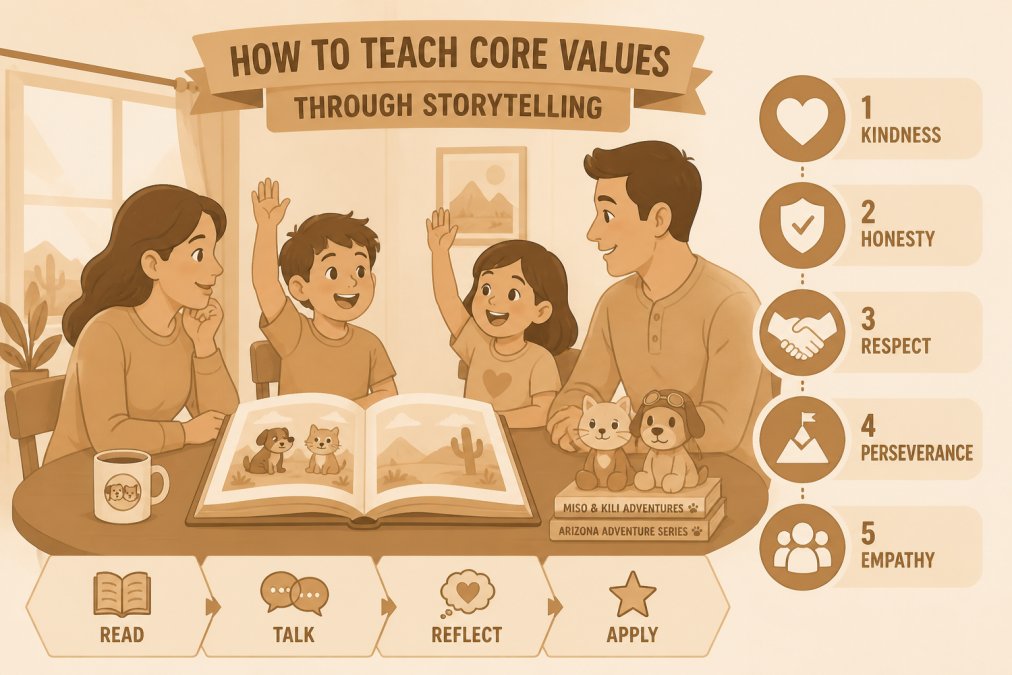
The discussion phase is where real learning happens. After reading, ask open-ended questions that invite your child to analyze character motivations: "Why do you think Miso made that choice?" "What would you have done differently?" These questions develop critical thinking while reinforcing embedded values.
| Value | Story Element | Discussion Prompt | Expected Learning |
|---|---|---|---|
| Integrity | Character tells the truth despite consequences | "Why was honesty important even though it was hard?" | Understanding that values matter more than avoiding short-term discomfort |
| Kindness | Character helps someone in need | "How did the character's kindness change the situation?" | Recognizing that compassion has real impact |
| Courage | Character faces a fear or challenge | "What was the character afraid of, and how did they overcome it?" | Building resilience and self-confidence |
| Teamwork | Characters solve a problem together | "How did working together make them stronger?" | Appreciating interdependence and cooperation |
| Respect | Character honors someone's differences or boundaries | "Why is it important to respect others' feelings?" | Developing empathy and social awareness |
Repetition across multiple stories reinforces values more effectively than a single narrative. When children encounter kindness, courage, or integrity in different contexts, these values become part of their internal framework.
Meaningful Gifts for 7 Year Olds: Adventure Stories That Inspire
Selecting meaningful gifts for 7 year olds requires understanding this developmental stage. At seven, children are building independence, developing stronger friendships, and grappling with more complex emotions. They're at the ideal age for chapter books and illustrated novels, old enough for sustained narratives, young enough to crave adventure and imagination.
Join the Miso & Kili Co-Pilot Club! →
Adventure stories serve this moment perfectly. They feed natural curiosity while embedding values-based lessons that support character growth. A meaningful gift sparks conversation, encourages re-reading, and builds confidence.
The Miso & Kili Hardcover Bundle makes an exceptional gift for this age group. The hardcover format signals this is a special, durable possession. The series spans multiple adventures, allowing a seven-year-old to grow into the collection. The books feature relatable protagonists facing challenges that mirror real childhood experiences: making new friends, overcoming fears, solving problems through cooperation.

The Miso & Kili Activity Book Bundle, 3 Adventures in One! extends the gift experience beyond reading. After finishing each story, children engage with companion activities through coloring, puzzles, and creative challenges. This combination keeps engagement high and provides multiple entry points for learning.
Consider the Miso & Kili's Space Adventures Softcover Bundle if your seven-year-old is drawn to science, exploration, or imaginative scenarios.

Values-based stories for children are a foundational tool for raising emotionally intelligent, ethically grounded young people. Whether you're a parent seeking to reinforce specific values, a grandparent looking for meaningful gifts, or an educator building a classroom library, the right stories make all the difference. Join the Miso & Kili Co-Pilot Club to receive monthly missions that extend these narratives into real-world adventures, turning story lessons into actionable character growth.
Frequently Asked Questions
Why are values-based stories important for child development?
Values-based stories shape how children understand right and wrong, build emotional intelligence, and develop social skills. Through narrative, children see characters face real challenges, make choices, and experience consequences, all without the pressure of real-world stakes. Stories about honesty, kindness, courage, and responsibility help children internalize these virtues as part of their identity. Research in cognitive development shows that children who engage with character-driven narratives develop stronger empathy and critical thinking skills than those who don't.
How do books that teach empathy to children actually work?
Stories create what researchers call 'narrative transportation', readers mentally step into a character's world and experience their emotions. When a child reads about a character's fear, joy, or struggle, their brain activates the same regions as if they were experiencing it themselves. This builds the neural pathways for empathy. Adventure stories like Miso & Kili's Flying Adventures show characters solving problems together, facing differences, and helping others, all scenarios that teach children to recognize and respond to others' needs.
What should I ask my child after reading a values-based story?
Ask open-ended questions that connect the story to their own experiences: 'How do you think Miso felt when...?' or 'What would you do in that situation?' Avoid yes-no questions. Instead, try: 'Why did the character make that choice?' 'What was the hardest part for them?' 'Who showed kindness in this story, and how?' These prompts turn reading into a conversation about values, helping children process moral lessons and apply them to their own lives.
Are values-based stories appropriate for advanced readers?
Yes. Strong stories don't become 'babyish' just because they teach values, they deepen. Advanced readers benefit from complex narratives with layered characters, unexpected plot twists, and moral nuance. Miso & Kili's Flying Adventures series spans ages 4-9 with increasing complexity: early books focus on friendship and courage, later books introduce problem-solving and resilience in more sophisticated scenarios. The key is choosing stories with rich storytelling, not just simple lessons.
How do I know if values-based stories will actually build my child's confidence?
Confidence grows when children see characters overcome challenges and succeed. Stories where protagonists face fear, make mistakes, learn, and try again teach resilience and self-belief. Miso & Kili's award-winning adventures feature two pilot cats who encounter problems, engine trouble, getting lost, meeting unfamiliar animals, and solve them through teamwork and persistence. When children see characters succeed after struggle, they internalize the message that they can handle challenges too. Pair reading with discussion to make this connection explicit.
This article was written using GrandRanker