

Why Reading Adventure Books Matters for Imagination
Table of Contents
- How Adventure Books Spark Imagination and Cognitive Growth
- The Benefits of Reading for Child Development
- Creative Writing Prompts for Kids to Extend the Adventure
- Frequently Asked Questions
Last Updated: September 21, 2026
How Adventure Books Spark Imagination and Cognitive Growth
Why reading adventure books matters for imagination comes down to one simple fact: stories give a child somewhere to go without leaving the room. At Miso & Kili's Adventures, we hear from families every week who watch their kids turn a couch cushion into a mountain ridge. The research on how story reading supports early brain development backs up what parents already sense.

Imagination is the mind's ability to build pictures, places, and people that aren't in front of you. Adventure stories train that muscle hardest because they keep asking the reader to fill in what the page leaves out. The American Academy of Pediatrics guidance on reading with children makes the same point from a pediatric angle: shared reading builds language and connection at the same time.
What most guides miss: the pictures matter more than the plot. A child who pictures the island works harder mentally than one who watches it on a screen.
The Benefits of Reading for Child Development
The benefits of reading for child development reach past vocabulary: empathy, problem-solving, and patience with hard questions.
- Empathy grows when a child feels a character's choice.
- Problem-solving develops as kids predict what a character tries next.
- Vocabulary happens through context, not memorization.
- Resilience builds when a favorite character keeps going.
- Critical thinking starts with "wait, that doesn't make sense."
A common mistake is treating these as separate lessons. They arrive together, usually while a kid is upside down on the sofa.
| Benefit | What It Looks Like | How to Support It |
|---|---|---|
| Empathy | Child asks why a character is sad | Talk about feelings in the story |
| Problem-solving | Child guesses the next move | Pause before turning the page |
| Vocabulary | Child uses a new word later | Reuse the word in daily talk |
Creative Writing Prompts for Kids to Extend the Adventure
Creative writing prompts for kids work best when they borrow characters the child already loves. The story ends; the world doesn't.
Miso & Kili's Flying Adventures →
- Write a new ending where the hero makes the opposite choice.
- Draw the map the characters never showed you.
- Invent a side character who joins halfway.
- Send the characters to a place your child has visited.
- Write one page from the villain's point of view.
The National Literacy Trust research on children's reading enjoyment points to choice as a major driver of reading for pleasure, and prompts work the same way. Let the child pick which one to run with.
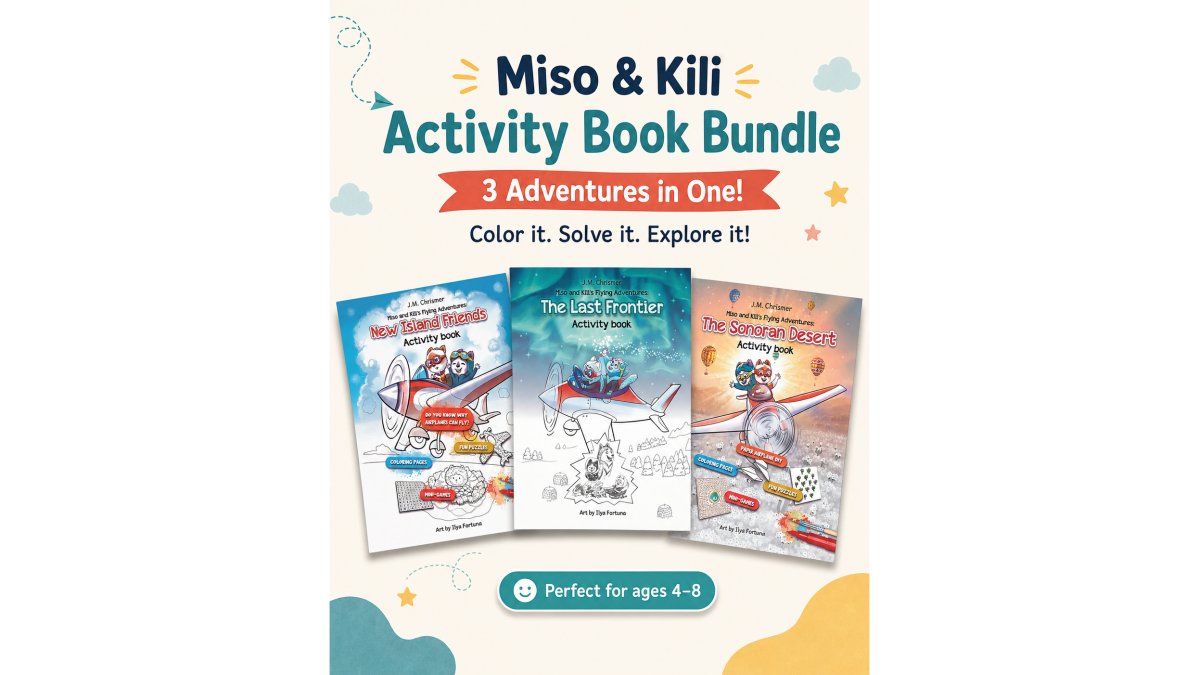
Our Miso & Kili Activity Book Bundle, 3 Adventures in One! gives kids coloring pages, puzzles, and creative prompts tied to the same island, Alaska, and desert settings they just read about, so the jump from reading to writing feels natural.
The real challenge isn't getting kids to read. It's keeping the world alive after the last page. Miso & Kili's Adventures builds for that second part, with award-winning books, signed copies, and plush companions that keep characters in a child's hands long after storytime ends. Start with the Miso & Kili Hardcover Bundle or the Complete Series Softcover Set, then join the Co-Pilot Club for monthly missions.


Frequently Asked Questions
Does reading adventure books improve a child's imagination?
Yes. Adventure books imagination works because the brain builds mental imagery from words alone, strengthening visualization and creative thinking. When kids follow characters like Miso and Kili through new worlds, they practice perspective-taking and emotional intelligence. Research on literacy shows that immersive reading activates the same neural pathways as real experience, supporting brain plasticity and lifelong learning.
How do adventure stories help children develop creative problem-solving skills?
Adventure plots present characters with obstacles that require resourcefulness. As kids read, they predict outcomes and imagine solutions alongside the hero. This builds problem-solving skills and resilience. Pairing stories with creative writing prompts for kids, such as rewriting a scene or inventing a new island, extends that thinking into original narrative structure and critical thinking.
What are the benefits of reading for child development?
The benefits of reading for child development include stronger vocabulary acquisition, improved academic performance, and greater empathy. Adventure books add exotic locations and world-building that expand curiosity. For ages 4 to 9, series like the Miso & Kili softcover set ($74.95) offer signed copies with real paw prints, making reading feel like a personal adventure and reinforcing a screen-free habit.