

Why Unplugged Play Is Important for Development
Table of Contents
- Why Unplugged Play Is Important for Development
- The Benefits of Unstructured Play for Toddlers and Young Kids
- Screen Free Educational Activities for Kids
- How to Reduce Screen Time for Children
- Frequently Asked Questions
Last Updated: September 25, 2026
Why Unplugged Play Is Important for Development
Unplugged play is open-ended, screen-free activity where a child decides what happens next, a reliable driver of healthy early-childhood development.
The Benefits of Unstructured Play for Toddlers and Young Kids
Unstructured play is child-led activity with no fixed rules, no adult script, and no screen, building cognitive, emotional, and motor skills at once.
- Problem-solving: A toddler stacking blocks that keep falling is running a real experiment in cause and effect.
- Emotional regulation: Pretend play lets a child rehearse fear, frustration, and joy safely.
- Motor skills: Gripping crayons, digging, climbing, and pouring build coordination.
- Social-emotional learning: Collaborative play teaches turn-taking, negotiation, and resilience.
- Creative thinking: An open-ended toy becomes a spaceship, a boat, or a cave.
Screen Free Educational Activities for Kids
Screen-free educational activities for kids work best when they are simple, low-prep, and repeatable. The goal is a child who can start something on their own.
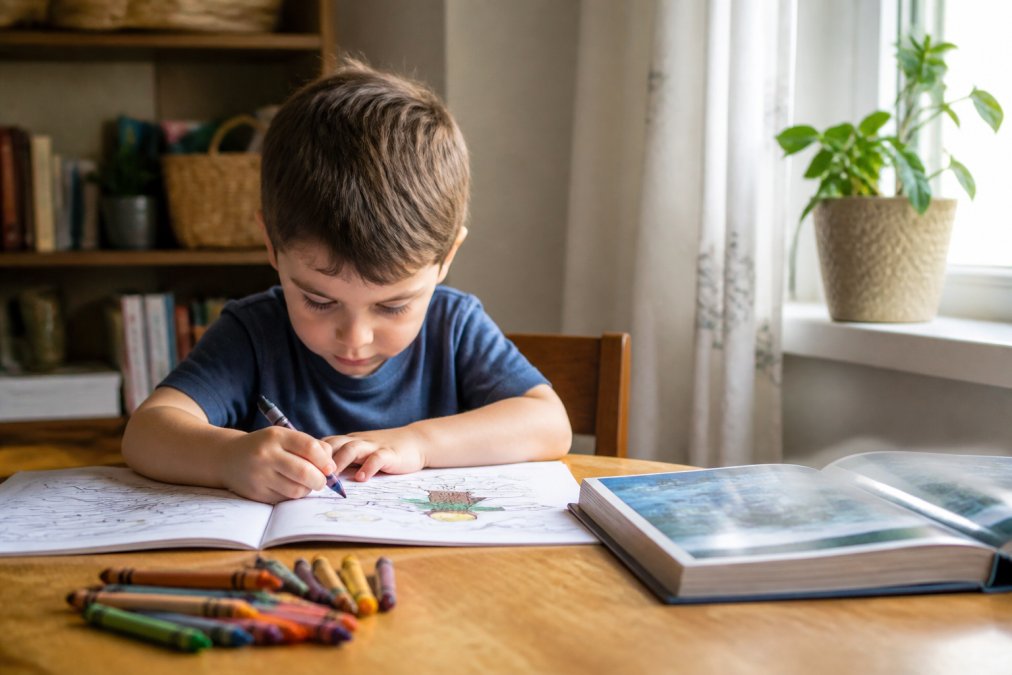
- Story-and-color pairing. Read a picture book, then hand over an activity or coloring book tied to the same story.
- Backyard missions. A five-minute challenge: find three things that are rough, two that are smooth, one that is alive.
- Kitchen science. Measuring cups, water, and a muffin tin. Let them pour and predict.
- Blanket forts. Pillows, sheets, and a flashlight. The fort becomes whatever they say it is.
- Neighborhood walks. Name what you see. Count birds. Collect leaves.
For a ready-made option, the New Island Friend Activity Book Bundle pairs an award-winning storybook with a matching activity and coloring book, priced at $24.99 for ages 4 to 8.

How to Reduce Screen Time for Children
Reducing screen time works better as a swap than a ban. Children resist subtraction. They rarely resist a better offer.
New Island Friend Activity Book Bundle →
- Protect one anchor hour. Pick a daily screen-free window at the same time every day.
- Replace, don't remove. Swap a show for a puzzle, a walk, or a chapter of a book.
- Model it. If adults scroll at the table, the rule will not hold.
- Make screens inconvenient. Charge devices in a common room, not the bedroom.
- Expect a rough first week. Boredom is the doorway to imaginative play.
The goal is not zero screens but a child with other options they genuinely enjoy, so the screen stops being the default.
Frequently Asked Questions
What are the developmental benefits of screen-free play?
Screen-free play builds cognitive development through problem-solving, imaginative play, and open-ended exploration. It strengthens fine motor skills and gross motor skills during physical activity, supports emotional regulation, and gives kids room to practice social interaction with siblings and peers. Unstructured play also encourages curiosity and independence, since children direct the activity themselves rather than following an app's prompts.
What is the difference between structured and unstructured play?
Structured play follows rules set by an adult, like a board game or a coached sport. Unstructured play is self-directed: a child decides what to build, draw, or pretend. Both matter, but unstructured play does more for creative thinking and executive function because kids plan, adjust, and solve problems on their own. Screen free educational activities for kids often blend the two, offering a prompt while leaving room for imagination.
How can parents encourage more unplugged play at home?
Start with a simple swap: replace one screen block each day with an open-ended option like crayons, blocks, or a storybook. Keep activity books and art supplies visible and reachable. Try a family reading or coloring time, and let kids pick the activity so it feels like their choice. The New Island Friend Activity Book Bundle, $24.99, pairs a storybook with puzzles and coloring pages, giving kids a ready-made screen-free option.