

How to Build Confidence in Children: A Parent's Guide
Table of Contents
- Step 1: Model Self-Compassion and Confidence
- Step 2: Use Descriptive Praise and Encourage Brave Steps
- Step 3: Try Activities to Build Self-Esteem in Kids
- Frequently Asked Questions
Last Updated: September 10, 2026
Step 1: Model Self-Compassion and Confidence
Children learn how to build confidence in children by watching adults, not by hearing instructions. This guide from Miso & Kili's Adventures starts here because modeling is the foundation.
When a parent handles a mistake with self-compassion, a child absorbs a powerful lesson: errors are information, not verdicts. According to the American Psychological Association's guidance on resilience in children, children develop resilience largely through observing how caregivers respond to stress and setback.
The tone you use with yourself becomes the tone your child internalizes, so modeling perfectionism while preaching self-compassion backfires.
Step 2: Use Descriptive Praise and Encourage Brave Steps
Descriptive praise names the specific effort you saw; generic praise ("good job") gives a child nothing to repeat.
Try "You kept trying that puzzle piece even when it didn't fit the first time" instead of "You're so smart." The first builds intrinsic motivation and a growth mindset; the second ties self-worth to a fixed trait (PubMed). Research summarized by the Center on the Developing Child at Harvard University supports the idea that responsive, specific feedback strengthens a child's sense of competence.
Brave steps work the same way: a shy child does not need a push into the deep end, but a ladder. Healthy risk-taking grows from small, winnable challenges.
| Instead of This | Try This | Why It Works |
|---|---|---|
| "You're so smart" | "You worked hard on that" | Builds growth mindset |
| "Don't be scared" | "Let's try one small step" | Validates feelings, invites action |
| "You always do this" | "Last time you handled it by..." | Tracks accomplishment, not failure |
For a child struggling with self-esteem, the goal is not eliminating fear but giving them evidence they can cope.
Join the Miso & Kili Co-Pilot Club! →
Step 3: Try Activities to Build Self-Esteem in Kids
Screen-free activities matching a child's interests do more for self-esteem than any compliment: finishing a puzzle, drawing, or chapter book gives proof of their own capability.
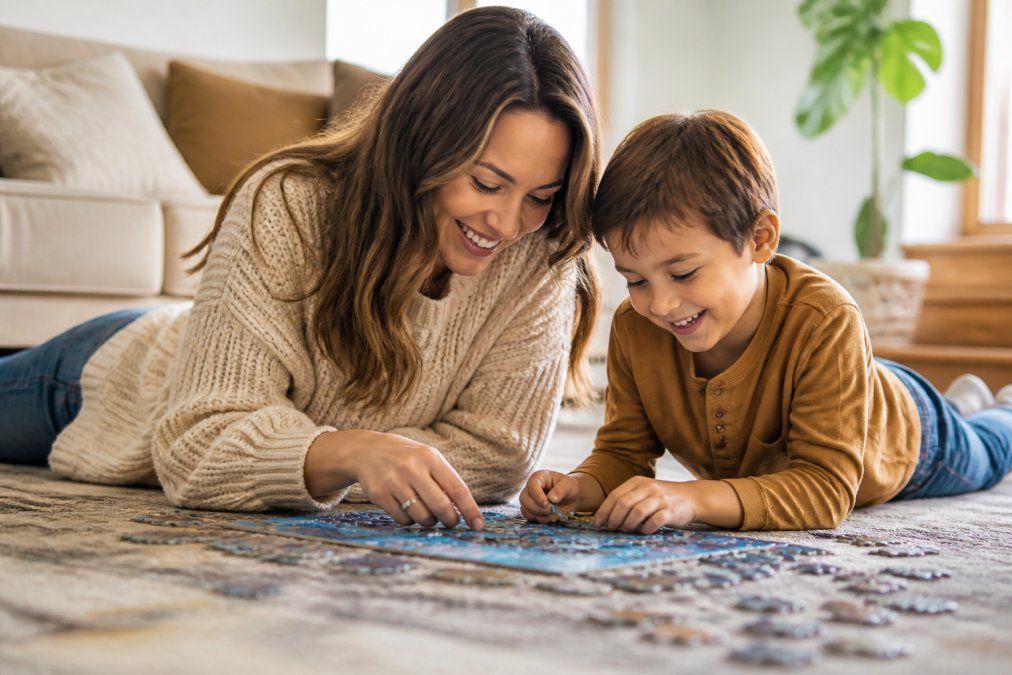
One practical approach pairs a story with a hands-on task: reading about a character facing a challenge, then coloring or solving puzzles tied to that story, lets a child process bravery through play rather than pressure. For families seeking books that build confidence in children, Miso & Kili's Adventures offers adventure-themed stories and activity bundles. The New Island Friend Activity Book Bundle pairs a storybook with a matching coloring book, while the Miso & Kili Activity Book Bundle collects three adventures in one set.


Building confidence in children is not a single conversation but a pattern of small, repeated moments where a child feels seen, capable, and safe to try again. At Miso & Kili's Adventures, we built our award-winning books and Co-Pilot Club monthly missions around that idea, giving families screen-free stories and activities that reinforce creativity, bravery, and a love of reading. To bring more of those moments into your week, join the Miso & Kili Co-Pilot Club and let the adventures do some of the confidence-building for you.
Frequently Asked Questions
What is the difference between self-esteem and self-confidence in kids?
Self-esteem is how much a child values themselves overall, while self-confidence is their belief in handling specific tasks. A child might feel confident riding a bike but still struggle with self-esteem after a bad day at school. Building both means praising effort, not just outcomes, and creating a non-judgmental space where mistakes are part of learning. Books and activities that show characters facing challenges help children connect these feelings to real life.
How do I encourage my child without over-praising them?
Focus on descriptive praise instead of generic compliments. Say 'You worked hard on that puzzle' rather than 'You're so smart.' This builds intrinsic motivation and a growth mindset. Pair praise with questions like 'What was the trickiest part?' to reinforce problem-solving skills. When children hear specific feedback, they learn that effort matters more than natural talent, which supports long-term confidence and resilience.
How can reading stories help a child develop a stronger sense of self?
Stories let children see characters face fears, make mistakes, and try again, which models brave steps and coping mechanisms. Books that build confidence in children often show relatable struggles, helping kids feel less alone. After reading, ask your child how the character felt and what they would do. This builds emotional intelligence and validation while reinforcing a love of reading.